


HOME Rental Development
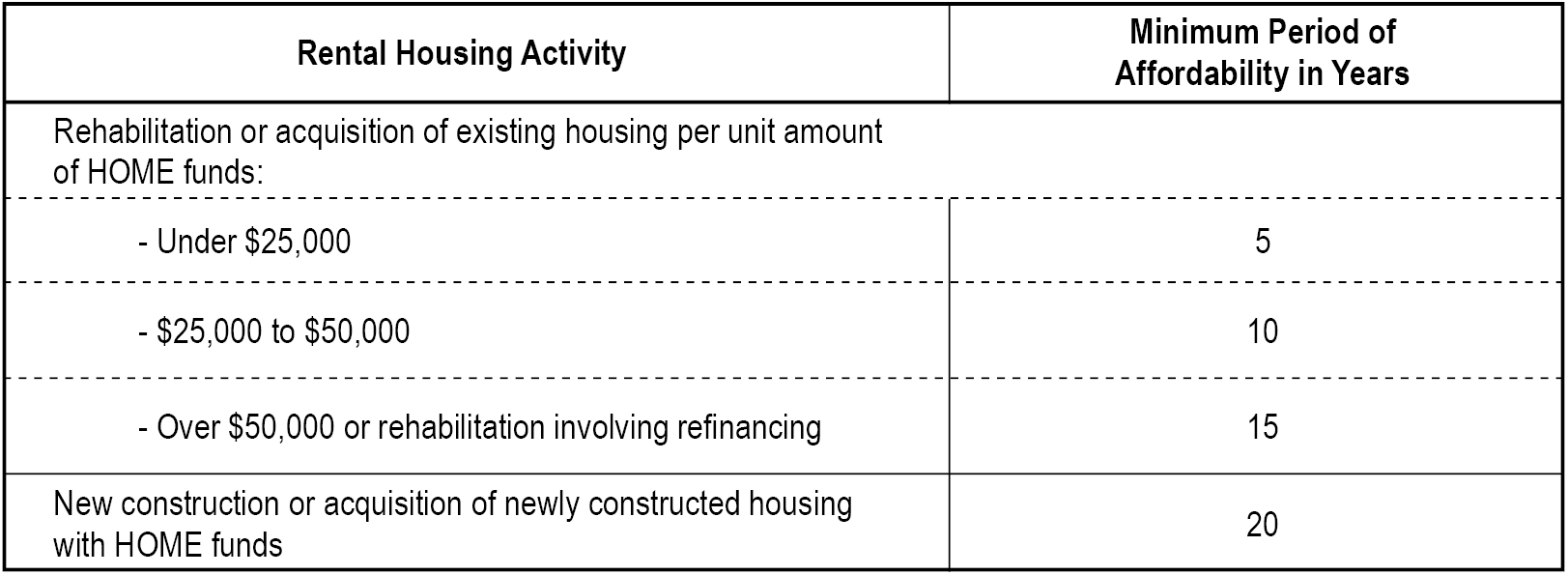
MHC’s HOME rental development program provides financial assistance to non-profit organizations and developers who have experience producing and managing affordable housing for low-income residents. HOME funds recipients agree to the income and rent restrictions required by federal regulations for the minimum required periods of affordability based upon the activity or amount of HOME funds subsidy per assisted unit. MHC will, to the extent practicable, underwrite the project, decide whether the project is ready to proceed, and confirm that the development has a financing gap that requires HOME funding.
HOME Rental Application Process
Overview
HOME funds are allocated to MHC annually. The Notice of Funding Availability (NOFA) informs the public of the intended application cycle start date and the tentative award notification date. An application workshop is held shortly after the NOFA is released. The workshop outlines the amount of HOME funds available for rental development, maximum award amounts, and the application selection criteria. The HOME Rental Application Guide is published online immediately after the application workshop and serves as the MHC policy for HOME rental development. The application is available online during the time period specified in the NOFA and/or the application guide. No late applications will be accepted.
MHC will use a ranking process to select projects for funding. Applications will be subject to a subsidy layering review of all sources of financing to determine that HOME fills a financing gap and does not result in federal funds providing excess subsidies. All awarded projects shall undergo a final underwriting analysis and subsidy layering review. MHC reserves the right to review other sources’ underwriting evaluations.
Eligible Applicants
- Non-profit organizations
- For-profit developers
- Public Housing Authorities (public housing units supported by Public Housing Capital or Operating Funds authorized by the 1937 Act are not eligible for HOME funding)
Eligible Activities
- New Construction only of permanent rental housing in the forms of multifamily or single-family housing.
- Rehabilitation only of permanent rental housing in the forms of multifamily or single-family housing, including the rehabilitation of existing HOME developments with HOME periods of affordability that have expired prior to the due date of the application cycle.
- Acquisition and Rehabilitation of permanent rental housing in the forms of multifamily or single-family housing.
- Acquisition of Vacant Land and New Construction of permanent rental housing in the forms of multifamily or single-family housing.
- Acquisition, Demolition, and Reconstruction of permanent rental housing in the forms of multifamily or single-family housing.
- Conversion of non-residential structures to permanent rental housing (considered rehabilitation unless two or more units are attached to the existing building, to which the activity will convert to new construction).
- Purchase and installation of manufactured homes for permanent rental housing.
HOME Rental Program Requirements
HOME “Program” & “Project” Rules
The HOME “Program Rule” (24 CFR 92.216) states that at initial occupancy, 90% of HOME-assisted units must be occupied by households with incomes at or below 60% of AMI. For MHC purposes, 100% of HOME-assisted units must be occupied by households with incomes at or below 60% of AMI at initial occupancy.
The HOME “Project Rule” (24 CFR 92.252) states that all HOME developments with five or more HOME-assisted units must have at least 20% of the HOME-assisted units occupied by households at or below 50% of AMI at initial occupancy and for the duration of the period of affordability.
Income Requirements (24 CFR 92.203)
Each family occupying a HOME-assisted unit is required to be eligible to ensure that income-targeting requirements are met. The MHC HOME program adopted the Part 5 income eligibility determination method. An individual does not qualify as a low-income family if the individual is a student who is not eligible to receive Section 8 assistance under 24 CFR 5.612.
The HOME program has income-targeting requirements, therefore each family occupying a HOME-assisted unit is income-eligible by determining the family’s annual income as defined in 24 CFR 92.216. MHC will use the method that will examine at least 2 months of source documents evidencing annual income (e.g., wage statement, interest statement, unemployment compensation statement) for the family.
During the period of affordability, the income of in‐place tenants must be recertified using source documentation at least every sixth year of the project’s period of affordability (e.g., in the sixth year, all in‐place tenants must be recertified using source documentation even if a given tenant is only in his/her second year of occupancy). In other years, owners must recertify the income of existing tenants annually using one of the methods specified in 24 CFR 92.203(b)(1)(i) or (ii).
Rent Restrictions (24 CFR 92.252)
High HOME units must be rented exclusively to tenants with household incomes, at the time of move-in, at or below 60% of AMI for the county, as adjusted by family size (80% AMI thereafter).
If a low-income family is participating in a program where the family pays as a contribution toward rent no more than 30 percent of the family's monthly adjusted income or 10 percent of the family's monthly income, then the maximum rent due from the family is the family's contribution. For all other cases, the rent does not exceed the lesser of:
- The fair market rent for existing housing for comparable units in the area as established by HUD under 24 CFR 888.111; or
- 30 percent of the adjusted income of a family whose annual income equals 65 percent of the median income for the area, as determined by HUD.
Low HOME units must be rented exclusively to tenants with household incomes at or below 50% AMI for the county both at initial occupancy and thereafter.
If a very low-income family is participating in a program where the family pays as a contribution toward rent no more than 30 percent of the family's monthly adjusted income or 10 percent of the family's monthly income, then the maximum rent due from the family is the family's contribution. All other Low HOME Rent units must have rent that meets one of the following requirements:
- The rent does not exceed 30 percent of the annual income of a family whose income equals 50 percent of the median income for the area, as determined by HUD. If the rent determined under this paragraph is higher than the fair market rent under #1 of the High HOME section, then the maximum rent for units under this section is the fair market rent under that section;
- The rent contribution of the family is not more than 30 percent of the family's adjusted income; or
- The unit is a LIHTC unit and has rents not greater than the gross rent for rent-restricted residential units as determined under 26 U.S.C. 42(g)(2).
Utility Allowances
The HOME rent limits are gross rent limits. The actual rent collected from a tenant must be adjusted considering an allowance for tenant-paid utilities. MHC must approve the project’s utility allowance (UA) annually. HOME regulations at 24 CFR 92.252(b) require that the UA for the project be based on the type of utilities (excluding telephone, cable, and broadband) used at the project and updated annually.
The following methodologies will meet HOME regulatory requirements and are generally acceptable to MHC. The Grants Management Division must approve the methodology selected by an applicant. The same methodology must be used for all HOME units within a single project, thereafter, approved by the Department.
- HUD Utility Schedule Model (HUSM) (https://www.huduser.gov/husm/uam.html)
- The utility allowance established by the applicable local public housing authority.
- Multifamily Housing Utility Analysis
- Energy Consumption Model (Engineer Model) (26 CFR 1.42-10(b)(4)(E))
HOME Rental Regulatory Requirements
Property Standards (24 CFR 92.251)
HOME Minimum Design Quality Standards
HOME-assisted housing must meet all applicable state and local codes, ordinances, and requirements. MHC will adhere to the HOME Minimum Design Quality Standards. MHC will follow written standards to ensure that project plans, specifications, and work write-ups follow state and local codes, ordinances, requirements, standards, and cost estimates. In the absence of a state or local building code, the International Existing Building Code of the International Code Council must be used. When the final plans and specifications are submitted, the Architect shall include a statement that the development has met the minimum criteria. Plans will be submitted as ¼ scales. At construction completion, the Architect must certify that the development complied with all the minimum requirements.
Considering that HOME regulations encourage the use of other funding sources to achieve financial feasibility, Tax-Exempt Bonds may be used in conjunction with HOME funds in developing units for low-income households. Tax-Exempt Bond applicants must apply for HOME and HTF through the LIHTC HOME/HTF set-aside. The standards noted in the QAP will also be utilized. These standards are designed to assist in achieving consistency throughout the state for all LIHTC activities and are intended to provide acceptable standards for development units rehabilitated according to LIHTC.
Minimum Design Quality Standards
New Construction Projects
HOME-assisted new construction and gut rehabilitation projects must meet all applicable state and local codes, ordinances, and zoning requirements. They must also meet the International Residential Code or International Building Code (as applicable), or state or local residential and building codes for new construction or gut rehabilitation.
Construction Progress Inspections
MHC will conduct progress and final inspections of construction to ensure that work is done in accordance with the applicable codes, the construction contract, and construction documents.
Accessibility
The housing must meet the accessibility requirements of 24 CFR part 8, which implements Section 504 of the Rehabilitation Act of 1973 (29 U.S.C. 794), and Titles II and III of the Americans with Disabilities Act (42 U.S.C. 12131-12189) implemented at 28 CFR parts 35 and 36, as applicable. Covered multifamily dwellings, as defined at 24 CFR 100.201, must also meet the design and construction requirements at 24 CFR 100.205, which implements the Fair Housing Act (42 U.S.C. 3601-3619).
A minimum of 5 percent of the units in the project (but not less than one unit) must be accessible to individuals with mobility impairments, and an additional 2%, at a minimum, of the units (but not less than one unit) must be accessible to individuals with sensory impairments. The total number of units in a HOME-assisted project, regardless of whether they are all HOME-assisted, is used as the basis for determining the minimum number of accessible units. Also, in a project where not all the units are HOME-assisted, the accessible units may be either HOME-assisted or non-HOME-assisted.
Energy Efficiency Standards
Newly constructed housing shall qualify as affordable housing under this part only if it meets the energy efficiency standards promulgated by the Secretary in accordance with section 109 of the Cranston-Gonzalez National Affordable Housing Act (42 U.S.C. 12709).
Disaster Mitigation
Where relevant, the housing must be constructed to mitigate the impact of potential disasters (e.g., earthquakes, hurricanes, flooding, and wildfires), in accordance with State and local codes, ordinances, or other State and local requirements, or such other requirements as HUD may establish.
Written Cost Estimates, Construction Contracts, and Construction Documents
The applicant must ensure the construction contract(s) and construction documents describe the work to be undertaken in adequate detail so that inspections can be conducted. MHC will review and approve written cost estimates for construction and determine that costs are reasonable.
Broadband Infrastructure
For a new construction housing project of a building with more than four (4) rental units, the construction must include installation of broadband infrastructure, as this term is defined in 24 CFR 5.100, except where MHC determines and, in accordance with 24 CFR 92.508(a)(3)(iv), documents the determination that:
- The location of the new construction makes installation of broadband infrastructure infeasible; or
- The cost of installing the infrastructure would result in a fundamental alteration in the nature of its program or activity or in an undue financial burden.
Carbon Monoxide and Smoke Detection
Carbon monoxide detection. A carbon monoxide alarm must be installed in the housing unit in a manner that meets or exceeds the carbon monoxide detection standards set by HUD through Federal Register publication.
Smoke Detection
- A hardwired smoke alarm must be installed:
- On each level of each housing unit;
- In or near each sleeping area in each housing unit;
- In the basement of each housing unit and in each common area of a project. A hardwired smoke alarm is not required in crawl spaces or unfinished attics of housing units;
- Within 21 feet of any door to a sleeping area measured along a path of travel; and
- Where a smoke alarm installed outside a sleeping area is separated from an adjacent living area by a door, a smoke alarm must also be installed on the living area side of the door.
- Each hardwired smoke alarm must have an alarm system designed for hearing-impaired persons.
- The HUD Secretary may establish additional standards through Federal Register publication.
- Following the relevant specifications of the International Code Council (ICC) or the National Fire Protection Association Standard (NFPA) 72 satisfies the requirements.
Rehabilitation Projects
MHC will ensure that knowledgeable inspectors and architects thoroughly inspect each dwelling for compliance with regulations and certifications. They will also ensure that each development complies with all the minimum requirements. Inspections will verify compliance with HOME rehabilitation standards, which are inclusive of health and safety, major systems, state and local codes, ordinances, zoning requirements, uniform physical condition standards, capital needs assessment, lead-based paint requirement, accessibility, disaster mitigation, construction documents, cost estimates, and frequency of inspections.
Health and Safety
MHC certifies that all dwellings will be free of all health and safety defects. All properties assisted with HOME funds must be free of hazardous materials, contamination, toxic chemicals and gases, and radioactive substances where a hazard could affect the health and safety of occupants or conflict with the intended use of the property.
MHC has identified the following life-threatening deficiencies that must be addressed within 24 hours if the housing is occupied:
NSPIRE LT Deficiencies
Major Systems
Major systems are structural supports, roofing, cladding, and weatherproofing (e.g., windows, doors, siding, gutters), plumbing, electrical, heating, ventilation, and air conditioning.
For multifamily rental housing projects of 26 or more total units, MHC will determine all work that must be performed in the rehabilitation of the housing and the long-term physical needs of the project through a capital needs assessment (CNA) of the project. If the remaining useful life of one or more major systems is less than the applicable period of affordability, MHC will ensure that a replacement reserve is established. All components, systems, and equipment of a development unit shall be in good working order and condition and be capable of being used for the purpose for which they were intended and/or designed. Components, systems, and/or equipment that are not in good working order and condition shall be repaired or replaced.
The capital needs assessment is critical to staying compliant with HUD regulations and necessary to provide the life expectancy and cost of major items needed to maintain a property. The CNA provides a detailed estimation of how much it will cost to maintain the property during the period of affordability. Applicants must create a budget for the future, assess what needs to be addressed immediately, and outline the expenses for urgent fixes.
The architect or engineer will provide a detailed report on the building’s structure and major items in both the interior and exterior. Specific improvement requirements and the costs associated with these changes should be noted. An estimate of the life of various building systems and a year-by-year assessment of when each component may need replacing or repairing should be provided. It is vital to ensure that a complete assessment is performed which can determine how to fund a replacement reserve account.
- The CNA will be completed by a competent independent third party such as a licensed architect and/or engineer.
- The assessment will include a site visit and a physical inspection of the interior and exterior of all units and structures.
- The assessment will consider the presence of environmental hazards such as asbestos, lead paint, and mold on the site. In addition, the assessment will examine and analyze the following:
- Site: including topography, drainage, pavement, curbing, sidewalks, parking, landscaping, amenities, water, sewer, storm drainage, gas, and electric utilities and lines.
- Structural systems: including exterior walls and balconies, exterior doors and windows, roofing systems, and drainage.
- Interiors: including unit and common area finishes (carpeting, tile, plaster walls, paint condition, etc.), kitchen finishes, cabinets and appliances, bathroom finishes and fixtures, and common area lobbies and corridors.
- Mechanical systems: including plumbing and domestic hot water, HVAC, electrical, lighting fixtures, fire protection, and elevators.
- Verification of modest amenities and anesthetic features and non-luxury improvements.
For multifamily rental housing projects containing less than 26 total units, an architect will complete a physical needs assessment.
Lead-Based Paint
HOME-assisted housing is subject to the Lead-Based Paint Poisoning Prevention Act (42 U.S.C. 4821-4846), the Residential Lead-Based Paint Hazard Reduction Act of 1992 (42 U.S.C. 4851-4856), and the regulations at 24 CFR 35, Subparts A, B, J, K, M, and R which govern lead-based paint poisoning prevention in residential structures. Applicants of any project requiring the rehabilitation of structures built before 1978 must comply with this regulation. A licensed lead-based paint inspector will be used to certify that units comply.
Accessibility
The applicant must meet the accessibility requirements in 24 CFR part 8, which implements Section 504 of the Rehabilitation Act of 1973 (29 U.S.C. 794), and Titles II and III of the Americans with Disabilities Act (42 U.S.C. 12131-12189) implemented at 28 CFR parts 35 and 36, as applicable. Covered multifamily dwellings, as defined at 24 CFR 100.201, must also meet the design and construction requirements at 24 CFR 100.205, which implements the Fair Housing Act (42 U.S.C. 3601-3619). Rehabilitation may include improvements that are not required by regulation or statute that permit use by a person with disabilities.
Substantial rehabilitation: A minimum of 5 percent of the units in the project (but not less than one unit) must be accessible to individuals with mobility impairments, and an additional 2 percent, at a minimum, (but not less than one unit) must be accessible to individuals with sensory impairments in a project with 15 or more units for which the rehabilitation costs will be 75 percent or more of the replacement cost.
The total number of units in a HOME-assisted project, regardless of whether they are all HOME-assisted, is used as the basis for determining the minimum number of accessible units, and, in a project where not all the units are HOME-assisted, the accessible units may be either HOME-assisted or non-HOME-assisted.
Moderate Rehabilitation: Less extensive rehabilitation than substantial rehabilitation undertaken in projects of 15 or more units, alterations must, to the maximum extent feasible, make the units accessible to and usable by individuals with handicaps, until a minimum of 5 percent of the units (but not less than one unit) are accessible to people with mobility impairments.
For this category of rehab, the additional 2 percent of unit requirements for individuals with sensory impairments does not apply. Alterations to common spaces must, to the maximum extent feasible, make those areas accessible.
Disaster Mitigation
Where relevant, the housing to be improved to mitigate the impact of potential disasters (e.g., earthquake, hurricanes, flooding, and wildfires) in accordance with State and local codes, ordinances, and requirements.
State and Local Codes, Ordinances, and Zoning Requirements
The housing must meet all applicable State and local codes, ordinances, and requirements or, in the absence of a State or local building code, the International Existing Building Code of the International Code Council.
HUD Housing Standards
Upon completion, the HOME-assisted project and units will be decent, safe, sanitary, and in good repair. This means that the HOME-assisted project and units will meet the standards in 24 CFR 5.703, except that the carbon monoxide detection requirements at 24 CFR 5.703(b)(2) and (d)(6) shall not apply. For all HOME-assisted projects and units, the requirements at 24 CFR 5.705 through 5.713 do not apply. At minimum, the applicant must correct the specific deficiencies published in the Federal Register for HOME-assisted projects and units.
MHC will follow the physical inspection procedures known as the Uniform Physical Conditions Standards (UPCS) for projects committed prior to April 14, 2026. Units must meet minimum standards of habitability and functionality, and all inspected items with an observed deficiency must be corrected. Construction progress inspections occur at 50% and 100% construction completion, unless an alternate schedule is agreed upon by both MHC and the applicant. Otherwise, the first inspection occurs at 50% construction completion. The 100% construction completion inspection will occur within twelve months after the end of construction. The entire site and all HOME-assisted units will be inspected at the 100% construction completion inspection. MHC will utilize the National Standards for the Physical Inspection of Real Estate (NSPIRE) for projects committed on or after April 14, 2026.
Capital Needs Assessments
For multifamily rental housing projects of 26 or more total units, the MHC will determine all work that to be performed in the rehabilitation of the housing and the long-term physical needs of the project through a capital needs assessment of the project.
Broadband Infrastructure
For a substantial rehabilitation project of a building with more than four (4) rental units, any substantial rehabilitation, as defined in 24 CFR 5.100, must provide for installation of broadband infrastructure, as this term is also defined in 24 CFR 5.100, except where MHC determines and, in accordance with 24 CFR 92.508(a)(3)(iv), documents the determination that:
- The location of the substantial rehabilitation makes installation of broadband infrastructure infeasible;
- The cost of installing broadband infrastructure would result in a fundamental alteration in the nature of its program or activity or in an undue financial burden; or
- The structure of the housing to be substantially rehabilitated makes installation of broadband infrastructure infeasible.
Carbon Monoxide and Smoke Detection
Carbon monoxide detection. A carbon monoxide alarm must be installed in the housing unit in a manner that meets or exceeds the carbon monoxide detection standards set by HUD through Federal Register publication.
Smoke Detection
- A hardwired smoke alarm must be installed:
- On each level of each housing unit;
- In or near each sleeping area in each housing unit;
- In the basement of each housing unit, and in each common area of a project. A hardwired smoke alarm is not required in crawl spaces or unfinished attics of housing units;
- Within 21 feet of any door to a sleeping area measured along a path of travel; and
- Where a smoke alarm installed outside a sleeping area is separated from an adjacent living area by a door, a smoke alarm must also be installed on the living area side of the door.
- Each hardwired smoke alarm must have an alarm system designed for hearing-impaired persons.
- The HUD Secretary may establish additional standards through Federal Register publication.
- Where the use of hardwired smoke detectors places an undue financial burden on the owner or is infeasible, MHC may provide a written exception to allow the owner to install a smoke detector that uses 10-year non-rechargeable, non-replaceable primary batteries. The smoke detector must be sealed, tamper-resistant, contain a means to silence the alarm, and otherwise comply with the requirements of this section.
- Following the relevant specification of the International Code Council (ICC) or the National Fire Protection Association Standard (NFPA) 72 satisfies the requirements.
Construction Documents and Cost Estimates
The applicant must ensure that the work to be undertaken will meet MHC's rehabilitation standards. The construction documents (i.e., written scope of work to be performed) must be in sufficient detail to establish the basis for a uniform inspection of the housing to determine compliance with the MHC's standards. MHC must review and approve a written cost estimate for rehabilitation after determining that costs are reasonable.
Frequency of Inspections
MHC will conduct an initial property inspection to identify the deficiencies that must be addressed. MHC will also conduct progress and final inspections to determine that work was done in accordance with work write-ups.
Post Construction Certification
At project completion, the project owner, architect, and contractor must certify that the project is constructed in accordance with HUD’s property standards. Form 0123 “Post Construction Certification” is available on MHC’s website or can be provided by the Housing Grant Officer. This form must be signed and notarized before the retainage payment, as well as before the project can be marked complete in IDIS.
Ongoing Property Condition Standards
To adhere to HOME rental requirements, property owners are required to certify on an annual basis that each unit in the development is suitable for occupancy, considering state and local health and safety codes and ordinances.
After project completion, onsite inspections will occur at least once every three years during the period of affordability. The Compliance Officer will randomly select a sample of HOME-assisted units for inspection to determine compliance based on “Table 1 to Paragraph (f)(3)(iii)—Minimum Inspection Sample Size for HOME Rental Housing Projects” at 24 CFR 92.251. For projects with four or fewer HOME-assisted units, all the assisted units will be inspected. Additionally, an inspection of the areas designated under UPCS (site, building exterior, building systems, and common areas) will also be conducted.
Any deficiencies considered “Life-Threatening Hazards” that generate health and safety issues must be addressed within 24 hours; “Non-Life-Threatening Hazards” must be addressed within 30 days for the 100% construction completion inspection and within 12 months for inspections during the period of affordability.
Site And Neighborhood Standards (24 CFR 92.202)
HOME-assisted new construction projects must comply with 24 CFR 92.202. Project owners must provide housing that is suitable from the standpoint of facilitating and furthering full compliance with the applicable provisions of title VI of the Civil Rights Act of 1964 (42 U.S.C. 2000d—2000d-4), the Fair Housing Act (42 U.S.C. 3601 et seq., E.O. 11063 (3 CFR, 1959-1963 Comp., p. 652), HUD regulations, and promotes greater choice of housing opportunities. Proposed sites for new construction must meet the requirements in 24 CFR 983.55(e)(2) and (3).
Site and neighborhood standards do not apply to rehabilitation projects under HOME. However, if project-based vouchers are used in a HOME rehabilitation unit, the site and neighborhood standards for project-based vouchers will apply. In addition, the requirements of 24 CFR Part 8, which implements section 504 of the Rehabilitation Act of 1973, apply to HOME and specifically address the site selection with respect to accessibility for persons with disabilities.
The site assessment must affirm the following:
- Is the site adequate in size, exposure, and contour to accommodate the number and type of units proposed, and are adequate utilities and streets available to service the site?
- Is the site suitable for facilitating and furthering compliance with applicable provisions of Title VI of the Civil Rights Act of 1964, the Fair Housing Act, Executive Order 11063, and HUD regulations?
- Is the site in an area of minority concentration?
- Do sufficient, comparable opportunities exist for housing minority families in the income range to be served by the proposed project and outside areas of minority concentration?
- Is the project necessary to meet overriding housing needs that cannot be met in that housing area?
- Does the site promote a greater choice of housing opportunities and avoid undue concentration of assisted persons in areas containing a high proportion of low-income persons?
- Is the housing accessible to social, recreational, education, commercial, and health facilities, and services that are at least equivalent to those typically found in neighborhoods consisting largely of unassisted, standard housing of similar market rents?
- Is the neighborhood one which is seriously detrimental to family life in which substandard dwellings or other undesirable conditions predominate?
- Is there activity in progress or a concerted program to remedy the undesirable situation?
- Is the proposed development for the elderly?
- If non-elderly, is the travel time and cost via public transportation or private automobile, from the neighborhood to places of employment providing a range of jobs for lower-income workers, reasonable?
Written Agreements 24 CFR 92.504
Before disbursing any HOME funds to any recipient, MHC must enter into a legally binding written agreement with that entity. The written agreement must ensure compliance with the requirements of the type of recipient and be a separate agreement from project financing documents (e.g., mortgage or deed of trust, or promissory note).
Subsidy Layering 24 CFR 92.250
MHC will perform a subsidy layering analysis before committing HOME funds to a project. The analysis will determine that costs are reasonable, sources are verifiable, and the use of funds and amounts requested are necessary and determined feasible. MHC’s evaluation of developments that use HOME funds in combination with other forms of assistance will ensure that no more than the necessary amount of HOME funds is invested in any one development. The subsidy layering review is conducted during the application period. Owners must disclose all other firm commitments for funding with the initial HOME rental housing application to MHC, and upon receiving any additional commitments of funding.
Cross-Cutting Federal Requirements
Environmental Review Requirements
Federally assisted projects are subject to a variety of environmental requirements. Therefore, an environmental review (ER) must be submitted to the Environmental Impact Officer within four (4) months of receiving a reservation of HOME funds letter.
Applicants should be familiar with these requirements and are strongly encouraged to discuss any questions they have with the Environmental Impact Officer before entering into a purchase agreement or submitting an application.
All HOME-assisted projects shall be implemented under environmental review regulations as defined in 24 CFR Part 58. For guided training, see the WISER modules on HUD Exchange.
Uniform Relocation Act (URA)
Every effort will be made to avoid the permanent displacement of all persons due to a HOME-funded project. MHC reserves the right to reject any application that fails to minimize the permanent displacement of tenants. If temporary relocation or permanent displacement is necessary, MHC will comply and will require compliance by owners with the Uniform Relocation Assistance and Real Property Acquisition Policies Act of 1970 (URA) and Section 104(d).
All rental housing projects fall under the requirements of the URA. Applicants must further document that any purchase of property meets the requirements of URA, including the provision of notices to the seller identifying the transaction as a voluntary sale not under the threat of eminent domain.
Additionally, for properties occupied by commercial or residential tenants at the time of application, URA requires certain notices to tenants in place as of the application for federal funds. Failure to provide such notices may result in substantial compliance costs or render a project ineligible. To ensure compliance with URA, applicants should consult the Grants Management staff before the submission of any application involving an occupied property to understand the requirements of URA.
For more information regarding URA, click here.
Labor Standards
The Davis-Bacon and Related Acts (DBRA) apply to HOME-funded construction projects with 12 or more HOME-assisted units. The DBRA include the following:
- The Davis-Bacon Act (DBA): Requires the payment of prevailing wage rates, as determined by the U.S. Department of Labor, to all laborers and mechanics. Construction includes alteration and repair, including painting and decorating, of public buildings or public works.
- The Contract Work Hours and Safety Standards Act (CWHSSA): Requires time and a half pay for overtime hours worked in excess of 40 in any workweek on a covered project. Applies to all federally-assisted contracts of $100,000 or more, except where the assistance is a loan guarantee or insurance.
- The Copeland Act (Anti-Kickback Act): Makes it a federal crime for any employer on a federally-assisted project to “kickback” any part of their wages, and requires employers to submit weekly certified payrolls, in addition to regulating permissible deductions.
- The Fair Labor Standards Act (FLSA): Contains federal minimum wage rates, overtime and child labor requirements, which generally apply to any labor performed. MHC will
- Review bids, contracts, and subcontracts for labor standards clauses and correct wage determination(s).
- Submit requests for additional wage classifications and wage rates.
- Provide contractor training regarding responsibilities for labor standards compliance.
- Review weekly certified payrolls for compliance and ensure employees are paid the correct wage rate.
- Conduct periodic employee interviews on site and verify payroll data to ensure employees are paid appropriate wages.
- Ensure Davis Bacon posters and wage determinations are posted on-site.
- Identify violations and enforce compliance with DBRA regulations.
- Report enforcement activities to the Department of Labor.
For more information regarding labor standards, click here.
Minority Business Enterprise & Women Business Enterprise (MBE/WBE) Plan
Developers must maintain an MBE/WBE plan that demonstrates marketing and solicitation of MBE/WBE businesses and contractors for the construction of the project. Contracts awarded and payments made to MBE/WBE businesses and contractors must be reported quarterly during the construction phase.
For more information regarding MBE/WBE, click here.
Section 3
Owners and developers of construction projects exceeding $200,000 in aggregate HUD funding (including HOME or HTF as well as HOME, CDBG, or other similar funding from a local government) are subject to the requirements of Section 3 of the Housing and Community Development Act of 1968 as outlined in 24 CFR 75. The purpose of Section 3 is to provide economic opportunities, particularly employment, generated by HUD-assisted development activity to low- and very low-income persons. In practice, MHC expects that all HOME/NHTF projects will be subject to Section 3.
Projects subject to Section 3 are required to take steps to achieve HUD-specified benchmarks (and maintain records and provide reporting) on total labor hours worked including by eligible “Section 3 workers” (25% of total labor hours) and by “Targeted Section 3 workers” (5% of total labor hours). More information is available on the HUD Exchange’s Section 3 page (Section 3 - HUD Exchange). The Section 3 report must be submitted quarterly during the construction phase.
Build America, Buy America (BABA)
The Build America, Buy America Act (BABA) requires that all iron, steel, manufactured products, and construction materials used for federally funded infrastructure projects are produced in the United States, unless otherwise exempt or subject to an approved waiver. This requirement is known as the “Buy America Preference (BAP)” and the specific requirements are codified in 2 CFR 184. BAP will apply to all HOME rental projects committed with HUD funds appropriated on or after August 23, 2024.
Products covered under the BAP include:
- Iron and steel: The cost of the iron and steel content exceeds 50% of the total cost of all the item’s components. All manufacturing processes, starting from the initial melting stage and continuing through the application of coatings, must occur in the United States.
- Construction materials: All manufacturing processes for the construction material must occur in the United States.
- Specifically Listed Construction Materials: Items include (1) non-ferrous metals; (2) lumber; and (3) plastic- and polymer-based composite building materials, pipe, and tube.
- Not Listed Construction Materials: Items include (1) all other plastic- and polymer-based materials (such as polymers used in fiber optic cables), (2) glass, (3) fiber optic cable, (4) optical fiber, (5) engineered wood, and (6) drywall.
- Manufactured products: Manufactured products must meet two production requirements. First, the final product must be manufactured in the United States. Second, at least 55% of the cost of the components making up the manufactured product must be associated with components that were mined, produced, or manufactured in the United States. Includes articles, materials, or supplies that have either been:
- Processed into a specific form or shape, or
- Combined with other articles, materials, or supplies to create a product with different properties than the individual articles, materials, or supplies.
Products should be classified into just one of these categories. The classification must be made based on the product’s status when brought to the work site.
BABA Waivers
HUD has defined two types of BABA waivers:
- General Waivers - Public Interest waivers granted at the departmental level that apply to all HUD-funded projects that meet the waiver criteria.
HUD general waivers offer flexibility to all HUD-funded infrastructure projects and should be carefully considered before pursuing a project-specific waiver. No formal request to HUD is needed to use these waivers. Applicants should maintain documentation that demonstrates the applicability of the waiver to a project, consistent with program regulations, and inform MHC that they intend to utilize a specific general waiver.
HUD currently has five general waivers available:
- Exigent Circumstances Waiver: The BAP may be waived if projects must be completed immediately to protect life, ensure safety, or prevent the destruction of property. Expires November 23, 2027.
- Tribal Recipients Waiver: For awards on or after January 10, 2025: BABA does not apply to awards and subawards to Tribes of $2.5 million or less. Expires January 10, 2030. Waiver for all manufactured products for Tribes. Expires September 30, 2026.
- Pacific Island Territories Waiver: The BAP is currently waived for all Federal financial assistance for infrastructure projects in the Northern Mariana Islands, American Samoa, and Guam. Expires January 10, 2030. Exceptions for some critical supply chains.
- Small Grants Waiver: The BAP can be waived for an entire project if the total project cost (including all sources of funding) is $250,000 or less. Expires November 23, 2027.
- De Minimis Waiver: If none of the other general waivers apply to a project, the de minimis waiver gives grantees additional flexibility to waive the BAP for a portion of a project. The de minimis waiver allows grantees to waive the BAP for materials whose total cost is less than 5% of all materials used in a project (up to $1,000,000).
- The total cost of materials includes all iron and steel, construction materials, and manufactured products, regardless of where the project falls in HUD's phased implementation. Example: $500,000 (total cost of (total cost ofÞmaterials) x 5% = $25,000 De Minimis limit
- If a grantee has a particular product(s) that is below the de minimis limit and no domestically produced equivalent is available, the BAP can be waived for that product(s) only.
- The BAP will still apply to the rest of the materials used in the project.
- Project-/Product-Specific Waivers - Targeted waivers that individual grantees may apply for. Applied to a specific project or a specific product(s) used in a project.
Before applying for a project-/product-specific waiver, the Applicant must confirm that the project is subject to the BAP; no general waivers apply to the project; the products for which you need a waiver exceed the de minimis limit; complete market research to attempt to locate domestic made equivalents for products that exceed the de minimis limit (NIST MEP supplier scouting); and submit the waiver application as early as possible and before funds have been spent on the project, if possible (OMB Made in America Office (MIAO) will not approve retroactive waivers for items that have already been purchased).
Only the direct recipient of Federal funding (MHC) can submit a waiver application. Applicants should coordinate with MHC for waiver submission.
HUD has defined three types of project-/product-specific waivers:
- Non-availability: No domestic product is available.
- Unreasonable Cost: Inclusion of a domestically produced product would increase the cost of the overall project by more than 25%.
- Public Interest: Complying with BABA would be inconsistent with the public interest.
The waiver process is anticipated to take a minimum of 6-8 weeks to complete.
- Complete 6-step analysis (Applicant).
- Complete online waiver application (MHC).
- Waiver application is reviewed by HUD. HUD may request additional supporting information.
- If approved by HUD, waiver is sent to OMB MIAO for review, including a 15-day public comment period.
- OMB MIAO will issue final decision, which HUD will communicate to MHC.
Minimum Documentation Requirements
- Determination of BAP applicability to the project - Even if the project is determined to be exempt, documentation should be retained in the grant files. The Optional BAP Applicability Checklist posted to HUD Exchange can assist with documentation.
- If a project is subject to the BAP, documentation that all Covered Materials subject to the BAP were procured from BABA-compliant sources.
- If a general waiver was applied to the project, documentation that supports that the project meets the conditions of the waiver.
- If a project-/product-specific waiver was obtained for the project, a copy of the approved waiver and market research supporting the need for the waiver.
For more information regarding the BAP, click here.
Nondiscrimination and Equal Opportunity
The following Federal nondiscrimination and equal opportunity guidelines apply to all Rental Housing projects and affect both the development and operation of assisted housing:
- The requirements of the Fair Housing Act (42 U.S.C. 3601-19) and implementing regulations at 24 CFR Part 100; Executive Order 11063, as amended by Executive Order 12259 (3 CFR 1958 B1963 Comp., P. 652 and 3 CFR 1980 Comp., P. 307) (Equal Opportunity in Housing) and implementing regulations at 24 CFR Part 107; and of the Civil Rights Act of 1964 (42 U.S.C. 2000d) (Nondiscrimination in Federally Assisted Programs) and implementing regulations issued at 24 CFR Part 1.
- The prohibition against discrimination based on age under the Age Discrimination Act of 1975 (42 U.S.C. 6101-07) and implementing Regulations at 24 CFR Part 146.
- The requirements of Section 504 of the Rehabilitation Act of 1973 (29 U.S.C. 794) and implementing regulations at 24 CFR Part 8.
- The requirements of Executive Order 11246, as amended by Executive Orders 11375, 11478, 12086, and 12107 (3 CFR 1964-65, Comp., p. 339) (Equal Employment Opportunity) and the implementing regulations issued at 41 CFR Chapter 60.
- The requirements of 24 CFR 5.105(a)(2) requiring that HUD-assisted housing be made available without regard to actual or perceived sexual orientation, gender identity, or marital status and prohibiting subrecipients, owners, developers, or their 1. agents from inquiring about the sexual orientation or gender identity of an applicant for, or occupant of, HUD-assisted housing to determine eligibility for the housing or otherwise make such housing available. This prohibition on inquiries regarding sexual orientation or gender identity does not prohibit any individual from voluntarily self-identifying sexual orientation or gender identity.
For more resources, click here.
Violence Against Women Act (VAWA)
HOME-assisted projects must comply with the requirements of the Violence Against Women Act (VAWA) as required by 24 CFR 92. VAWA provides certain additional tenant protections to applicants and tenants who are victims of domestic violence, sexual assault, and/or stalking. In general, among other requirements owners must provide notices to all tenants of the VAWA provisions, may not deny an application, or terminate or refuse to renew a lease because of a person’s status as a victim or based on criminal activity related to such status, and must allow for the bifurcation of a lease to evict the perpetrator of such criminal activity while allowing the victim to maintain occupancy.
For more information regarding VAWA, click here.
Language Access
Recipients of federal financial assistance, including HOME funds, are required to provide meaningful access to their programs and services for persons with limited English proficiency (LEP). The U.S. Supreme Court has held that failing to take reasonable steps to ensure meaningful access for LEP persons is a form of national origin discrimination prohibited by Title VI of the Civil Rights Act of 1964.
Recipients of HOME funds should develop, and periodically update, a written LEP plan that describes their language assistance services and explains how staff and LEP people can access those services. Guidance regarding LEP compliance can be accessed on the HUD website here.
Excluded Parties
MHC will not fund projects owned, developed, or otherwise sponsored by any individual, corporation, or other entity that is suspended, debarred, or otherwise precluded from receiving federal awards. Furthermore, the owner may not contract with any other entity (including but not limited to builders/general contractors, property management companies, or other members of the development team) that is suspended, debarred, or otherwise so precluded. Similarly, the general contractor will be required to determine that subcontractors are not so precluded (www.sam.gov).
Affirmative Marketing (24 CFR 92.351)
Project owners must develop and adopt and follow written affirmative marketing procedures and requirements for rental projects containing five or more HOME-assisted housing units, regardless of the specific activity the HOME funds will finance (e.g., acquisition, rehabilitation, and/or new construction). Affirmative marketing requirements and procedures also apply to all HOME-funded programs.
The objective of affirmative marketing is to ensure that project owners design and employ marketing plans that promote fair housing by ensuring outreach to all potentially eligible households, especially those least likely to apply for assistance. Affirmative marketing consists of actions to provide information and otherwise attract eligible persons to available housing without regard to race, color, national origin, sex, religion, familial status (persons with children under 18 years of age, including pregnant women), or disability. The affirmative marketing requirements also apply to projects targeted to persons with special needs. If MHC’s regulatory agreement with a project owner permits a rental housing project to limit tenant eligibility or to have a tenant preference in accordance with §92.253(d)(3), the project owner must have affirmative marketing procedures and requirements that apply in the context of the limited/preferred tenant eligibility for the project.
The affirmative marketing procedures must describe specific steps that must be taken to ensure applicants who are unlikely to apply for housing without special outreach have equal access to housing opportunities generated by the use of HOME Program funds. There are five elements that each project owner’s marketing procedures must include:
- A description of how the project owner plans to inform potential tenants about Federal fair housing laws and its affirmative marketing policy;
- The requirements and practices that the owner of HOME-funded housing will follow to carry out the affirmative marketing procedures and requirements;
- A statement of procedures to be used by the owner to inform and solicit applications from persons in the housing market area who are least likely to apply for the housing without special outreach;
- A list of what records the owner will keep regarding efforts made to affirmatively market HOME-assisted units, and to assess the results of these actions; and
- A description of how the owner will annually assess the success of affirmative marketing action(s) and what corrective actions will be taken where affirmative marketing requirements are not met
Conflict of Interest (24 CFR 92.356)
Conflicts of interest apply to any person who is an employee, agent, consultant, officer, elected official, or appointed official of the grantee or sub-grantee. No persons described above who exercise or have exercised any functions or responsibilities for activities assisted with HOME funds, or who are in a position to participate in a decision-making process, or gain inside information concerning these activities may obtain a financial interest or financial benefit from a HOME-assisted activity; or have a financial interest in any contract, subcontract, or agreement concerning the HOME assisted activity, either for themselves or those with whom they have business or immediate family’s ties, during their tenure or for one year thereafter.
Additional Information
Award Reservation Announcements
Applicants will be notified in writing of award reservations or application denials. Applicants have 10 business days after written notification to appeal a denied application. Appeals submitted outside the 10-day window will not be considered.
Applications that meet threshold, scoring, and underwriting requirements are recommended for funding and will receive a reservation letter, subject to available funds. Conditions of the reservation may include:
- MHC’s receipt of the HUD Authority to Use Grant Funds following completion of the environmental review process (as applicable)
- Letter from HUD or local public housing authority if a future commitment of project-based rental assistance/vouchers is expected
- Pre-closing Underwriting/SLR Analysis
- Other items noted in the project-specific reservation letter
Form of Assistance
MHC has the discretion of allowing HOME awards to be in the form of interest-bearing loans, non-interest bearing loans, and deferred interest loans, based on the results of the subsidy and underwriting review. A HOME award to a 4% Tax-Exempt Bond development must be structured as a loan to mitigate risk to eligible basis. Loans may be structured as payable from available cash flow to minimize project debt and maximize affordability to lower-income households. Terms of loans will be set by MHC underwriting and designed to ensure that the use of HOME dollars is maximized. The project must maintain viability and the greatest possible return on investment. Evidence of the award of any additional sources of funding must be provided to MHC no later than the due date set out in the reservation letter.
Implementation Workshop
All applicants who receive a reservation of HOME funds must attend the mandatory implementation workshop listed in the Important Dates table in the application guide. Failure to attend this workshop automatically results in the withdrawal of the award reservation. The workshop will outline the events after an award reservation and provide an overview of the HOME program requirements. Members of the property management team are strongly encouraged to attend this workshop as well.
Pre-Closing Conditions
Once the applicant meets the conditions delineated in the reservation letter, the applicant will be required to provide an updated budget, project schedule, and final sources. A HOME commitment letter with an expected loan closing date will be sent. For applicants applying for HOME funds before the receipt of all other funding sources, the loan closing may be contingent on:
- The applicant’s receipt of a 4% Tax-Exempt Bond 42M letter
- Executed Housing Assistance Payments (HAP) contract if receiving project-based rental assistance/vouchers
- Final award letters from all other funding sources
- Acceptable final underwriting analysis comparable to syndicator’s closing model
A Notice to Proceed with Loan Closing will be sent to MHC attorneys to initiate the loan closing process. The loan closing is expected within 30 days of the notice to proceed.
Loan Closing Process
- MHC legal counsel will serve as the closing attorney for the loan received according to the HOME program.
- MHC or its counsel will provide a closing checklist that will include a list of requested due diligence items that must be provided to MHC’s counsel before closing.
- The recipient must provide for MHC a lender’s policy of title insurance, issued by a title insurance company satisfactory to MHC, with endorsements required by MHC.
- At closing, the recipient must pay certain closing costs incurred by MHC, including, without limitation, the fees of MHC’s counsel.
- The following HOME loan closing documents will be provided in advance of closing:
- Promissory Note.
- HOME Regulatory Agreement (the “Regulatory Agreement”).
- Deed of Trust, Assignment of Rent & Leases, Security Agreement, and Fixture Filing.
- Declaration of Restrictive Covenants; and
- UCC financing statement.
- The Regulatory Agreement will contain, among other items, the following:
- Certifications by the recipient to comply with all HOME requirements and associated federal and state laws and regulations.
- Performance goals and benchmarks.
- Restrictions on the use of HOME funds for eligible project costs; and
- Requirements for completing eligible projects on time (Schedule of Completion).
- MHC will consider the execution of subordination agreements when required by senior lenders, although such must allow for repayment to and recapture by MHC, as required by federal regulations, without restriction.
Loan Closing & Home Commitment Package
After the loan closing, the recipient will receive a “Welcome Package” including a letter with attachments to help them throughout the construction period. The post-loan closing package is included in the Documents and Links section. A physical letter will be mailed to the recipient’s mailing address along with a USB flash drive with all the included documents.
Notice to Proceed with Construction
Following the loan closing and execution of the regulatory agreement, a notice to proceed with construction will be emailed to the recipient. Construction will be expected to start within six months of the loan closing date. Failure to do so will require a plan of action to be submitted to MHC. The Housing Grant Officer will be the primary point of contact for the owner until the project is completed according to HOME regulations. This person is responsible for processing draw requests, reviewing construction progress and compliance with labor standards, negotiating and seeking internal approvals on any proposed contract changes, and coordinating with Compliance staff on the handoff of the project as it approaches project completion.
The construction must be completed within 24 months after the execution of the regulatory agreement between the recipient and MHC. Construction completion can be evidenced by the certificate of occupancy or certification by the project architect (AIA Report). However, the project must be marked complete in the Integrated Disbursement and Information System (IDIS) within 180 days of the final draw.
Construction Period Reporting Requirements
Owners are required to report quarterly during the development phase and lease up phase. Quarterly reports will be due on the 5th of the month following the end of the prior quarter.
Due Dates:
April 5th – reflecting the Project period January, February, March
July 5th – reflecting the Project period April, May, June
October 5th – reflecting the Project period July, August, September
January 5th – reflecting the Project period October, November, December
Furthermore, during the construction phase, owners must provide Section 3 and MBE/WBE quarterly reports. If necessary, owners must provide monthly reports detailing construction progress and barriers to progress, copies of invoices being paid, and evidence of appropriate lien waivers.
Disbursement of Funds
HOME awards will be disbursed at 50% of project completion and at 100% completion. Ten percent (10%) of the total award will be held as retainage until monitoring, closeout, and compliance completion of the project. At MHC’s discretion, an alternative disbursement schedule may be considered at the request of the owner before the loan closing.
MHC may identify special conditions that must be satisfied before the drawdown of HOME funds. Special conditions may arise due to documentation required to comply with MHC’s policy and procedures, federal HOME regulations, and other federal crossing-cutting requirements compliance. Any drawdown of funds is conditioned upon the provision of satisfactory information by MHC about the project and compliance with other procedures, as specified by HUD.
Recipients may not request disbursement of funds until funds are needed for payment of eligible costs. This will be documented by an AIA Report signed by the developer’s architect certifying that the development is at the percentage of completion and confirmation of funds requested.
MHC requires projects to be inspected to confirm that development units conform to the phases of completion. In addition to the Architect certification, MHC’s staff will perform an inspection of the property. Recipients are required to notify MHC to schedule the inspection. Once the inspector provides written authorization that the property complies and is at the percentage of completion, documents may be submitted requesting disbursement of funds.
MHC will abide by Mississippi Code §31-7-305, which allows for the processing of requests for cash within forty-five (45) days of receipt. MHC staff will process requests for cash once all information has been verified and is approved for payment.
Recipients are required to prepare and submit a Rental Setup & Completion form identifying allocated HOME units and beneficiaries within 60 calendar days of the date of the final project drawdown.
Any HOME funds invested in housing that do not meet the affordability requirements for the period specified in the written agreement as applicable, must be repaid. Any HOME funds invested in a project that is terminated before completion, either voluntarily or otherwise, must be repaid.
Ongoing Compliance & Asset Management
Once a project is completed, it is assigned to the Grants Compliance Monitoring Officer who will become the main contact during project closeout, throughout the period of affordability, extended commitment period, and life of the HOME loan, whichever is longer. The Grants Compliance Monitoring Officer will be responsible for overseeing annual and periodic on-site monitoring of the project. (HOME/HTF Compliance)
Documents & Links
Tips for a Successful Application
- Read the guide carefully and follow instructions.
- Submit complete documents—incomplete applications may be delayed or rejected.
- Contact our team if you have questions—we’re here to help.
Upcoming Deadline
October 30, 2026 - Online Application Submission Deadline*
Announcements
BULLETINS
#26-002: Waivers for 9% LIHTC Developments applying for HOME and/or HTF funds (7/8/2026)
#25-002: 2025 HOME Rental Application Guide (11/24/2025)
#24-003: 2024 HOME Rental Application Rating Form (08/7/2024)
#23-006: Income Limits (06/15/2023)
#23-005: Rent Limits (06/13/2023)
#23-003: NOFA (06/13/2023)
#23-002: Appeals Process (2/24/2023)
#23-001: Waivers for 9% LIHTC Developments applying for HOME and/or HTF funds (2/23/2023)
NOFAs
FY2026 Notice of Funding Availability
REOPEN: NOFA 2025 (11/13/2025)
UPCOMING EVENTS
- August 19, 2026 - Application Workshop
- August 21, 2026 - Application Open
- October 30, 2026 - Online Application Submission Deadline*
- January 13, 2027 - Funding Announcement
Award Recipient Resources
Post-Loan Closing Checklist
Exhibit 1 - Quarterly Construction Status Report Form
Exhibit 2 - Section 3 Quarterly Report
Exhibit 3 - MHC MBE & WBE Quarterly Report
Exhibit 4 - Physical Inspection Request Form
Exhibit 5 - MHC Request for Cash revision
Exhibit 6 - HOME Rental Project-Set Up & Report-Form
Exhibit 7 - W-9 Form
Exhibit 8 - ACH Credit Authorization Form
Exhibit 9 - Project Completion Schedule
Exhibit 10 - Post Construction Certification Form
HOME Rental Team
Kimberly Stamps
Assistant Vice President of Grants Management (HOME/HTF)
Jamie Bouie
Housing Grant Officer (HOME Rental/HTF)